Investing in a home energy storage battery is one of the most effective ways to maximize solar self-consumption, lower your grid electricity bills and secure backup power for your household. However, with so many options on the market, homeowners and installers often struggle with three questions: how much capacity to buy, how long the battery will last and whether it will work with their inverter.
Choosing the wrong solar battery or misconfiguring the system can quickly turn a smart investment into an unnecessary expense. This practical guide shows you how to choose the right system without overpaying.
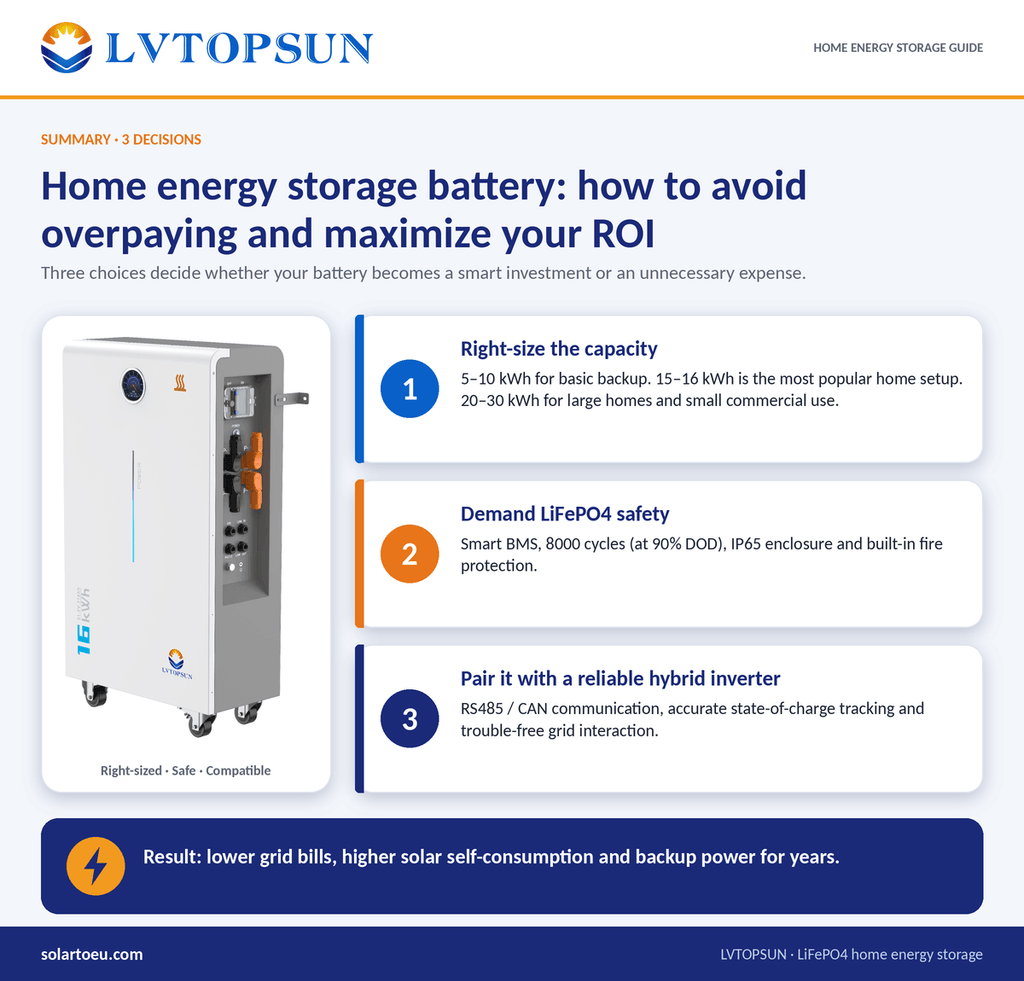
1. Right-Sizing Your Home Energy Storage Battery: From 5 kWh to 30 kWh
The right capacity depends on your daily household energy consumption and the size of your PV array. A system that is too small wastes solar energy, while an oversized one raises upfront costs without adding value.
Residential systems generally come in a few standard modular sizes:
- Small to medium households (5–10 kWh): ideal for basic backup power and shifting energy to the evening.
- Standard residential setup (15–16 kWh): the most popular choice for full daily autonomy. A single 16 kWh module, such as a 51.2 V, 314 Ah unit, offers the best balance between cost and usable energy. See our 16 kWh LiFePO4 battery module.
- Large homes and small commercial use (20–30 kWh): built for high-demand properties that need extended backup or multi-phase integration.
Whether you choose a low-voltage system for a standard home or a high-voltage configuration for larger applications, look for a modular design so you can add capacity as your needs grow. You can compare options in our solar battery range.
2. Safety and Durability: Why LiFePO4 Chemistry Matters
When installing a home energy storage battery inside or near a residential property, safety is paramount. Modern lithium storage solutions rely on LiFePO4 (lithium iron phosphate) chemistry, which offers superior thermal stability and a longer service life than traditional lithium-ion alternatives.
Look for these key features:
- Smart BMS integration: an intelligent battery management system continuously monitors voltage, temperature and cell health.
- Long cycle life: high-grade cells deliver around 8,000 cycles (at 90% depth of discharge), which means over 10 years of reliable daily operation.
- Weatherproof protection: an IP65 rating means the enclosure is dust-tight and protected against water jets, so the battery can also be installed outdoors.
- Built-in safety systems: premium models include an automatic fire-suppression device for added protection.
3. Inverter Compatibility: Connecting Your Battery with Deye and Solis
A home energy storage battery cannot work effectively without seamless communication with your solar inverter. A protocol mismatch between the battery’s BMS and the inverter can cause system errors, charging inefficiencies or a complete shutdown.
To avoid technical problems, buy your equipment from an authorized Deye distributor or Solis distributor. Pairing the battery with an industry-standard hybrid inverter, such as Deye or Solis, ensures plug-and-play RS485/CAN communication, accurate state-of-charge tracking and reliable grid-interactive features.
4. Smart Energy Management: Self-Consumption and Peak Shaving
Instead of simply storing surplus solar energy, a modern home energy storage battery helps you actively reduce energy costs through smart grid interaction and dynamic tariffs:
- Maximize autonomy: store peak mid-day solar power to cover high evening demand without buying expensive electricity from the grid.
- Dynamic tariff optimization: charge the battery from the grid during off-peak hours, when prices are low, and discharge it during high-cost peak hours.
- Uninterrupted backup power (UPS): protect critical household appliances against sudden outages with instant transfer switching.
Secure Your Energy Future with Confidence
Avoiding unnecessary expenses on your home energy storage battery comes down to three choices: right-sizing the capacity, demanding top-tier LiFePO4 safety features and pairing the storage with a reliable hybrid inverter such as Deye or Solis.
Whether you need a wall-mounted unit, a rack battery or a complete high-capacity BESS, choosing a home energy storage battery with a long cycle life supports long-term ROI and greater energy independence. Not sure which configuration fits your home?