
“What size battery should I buy?” is the question we hear most from homeowners and installers. Buy too small and the battery is empty by 9 p.m. Buy too big and you pay for capacity you never use.
The good news is that you can size a home battery with a simple calculation. In this guide you will find a 5-step calculator, a quick lookup table and three worked examples: a home with a heat pump, a home with an electric car and a home without electric heating. We use the LVTOPSUN LVTS-512314-G4H (16.07 kWh) and the smaller LVTS-512200-G3 (10.24 kWh) as examples.
The short answer
| Household type | Typical use per day | Energy to cover (about 60%) | Batteries needed |
|---|---|---|---|
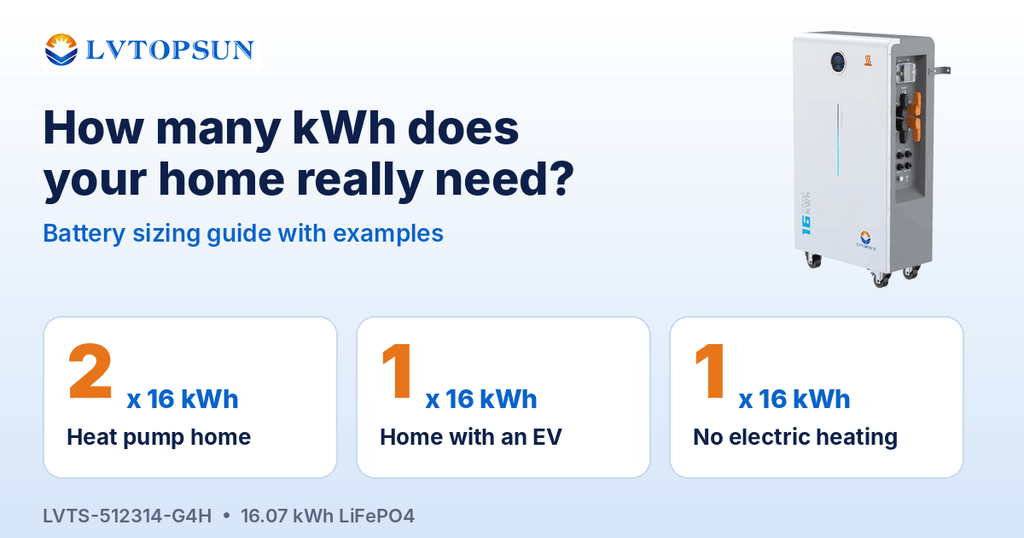
| Home with a heat pump (cold winter day) | 28 kWh | 16.8 kWh | 2 × LVTS-512314-G4H (1 covers about 80%) |
| Home with an electric car (12,000 km a year) | 15.3 kWh | 12.1 kWh | 1 × LVTS-512314-G4H |
| Home without electric heating (family of four) | 11 kWh | 6.6 kWh | 1 × LVTS-512200-G3 or 1 × LVTS-512314-G4H |
The rest of this article explains where these numbers come from, so you can repeat the calculation for your own home.
What do homes actually consume?
Household electricity use varies enormously across Europe. In Poland, Statistics Poland reports an average of 1,832 kWh per household in 2024 (about 1,612 kWh in cities and 2,269 kWh in rural areas). Across the EU, the most common consumption band used by Eurostat for comparing prices is 2,500 to 5,000 kWh per year.
Two things push consumption far above these averages:
- A heat pump. According to PickHVAC, a central heat pump typically draws about 1.5 to 3.5 kW while running and can use 15 to 60 kWh per day for heating, depending on size and weather.
- An electric car. The ICCT puts the EU average real-world consumption of new electric cars at about 20 kWh per 100 km and uses an average annual mileage of 12,000 km. Real consumption is higher in winter. In one ICCT driver’s long-term data, it averaged about 14 kWh/100 km in summer and nearly 26 kWh/100 km in December.
Solar production also changes with the seasons. For Warsaw, profileSOLAR estimates about 5.7 kWh per day per installed kW in summer, but only about 0.9 kWh per day per kW in winter. That is why battery size should be checked against your winter consumption, not only the annual average.
The 5-step home battery size calculator
Step 1: Find your daily consumption. Divide your annual consumption (from your electricity bill) by 365. If you have a heat pump or an EV, calculate a winter day separately, because it can be two to three times higher.
Daily kWh = annual kWh ÷ 365
Step 2: Decide what share the battery should cover. Solar panels supply the daytime hours. The battery covers the evening, night and early morning. In most households this is about 60% of daily consumption. We use 60% as a planning assumption. If you want to cover everything, use 100%.
Energy to cover (kWh) = daily kWh × 0.6
Step 3: Add anything charged from the battery. If you want the battery to charge your electric car in the evening, add that energy to the number from step 2.
Step 4: Divide by usable energy per battery. The nominal capacity is not all usable. For planning we assume 90% depth of discharge and 92% inverter efficiency.
| Battery | Nominal energy | Usable energy (planning figure) |
|---|---|---|
| LVTS-512314-G4H | 16.07 kWh | about 13.3 kWh |
| LVTS-512200-G3 | 10.24 kWh | about 8.5 kWh |
Number of batteries = energy to cover ÷ usable energy, rounded up
Step 5: Check the power. Capacity is only half the story. Add up the devices that run at the same time (heat pump, induction hob, wallbox, oven). The LVTS-512314-G4H can discharge up to 10.24 kW (200 A), but your hybrid inverter’s rating is often the real limit.
Quick lookup table
Use this table if you only know your annual consumption. It applies the 60% rule and the usable energy figures above.
| Annual consumption | Per day | Energy to cover | LVTS-512314-G4H | LVTS-512200-G3 |
|---|---|---|---|---|
| 2,500 kWh | 6.8 kWh | 4.1 kWh | 1 | 1 |
| 3,500 kWh | 9.6 kWh | 5.8 kWh | 1 | 1 |
| 5,000 kWh | 13.7 kWh | 8.2 kWh | 1 | 1 |
| 7,000 kWh | 19.2 kWh | 11.5 kWh | 1 | 2 |
| 10,000 kWh | 27.4 kWh | 16.4 kWh | 2 | 2 |
| 12,000 kWh | 32.9 kWh | 19.7 kWh | 2 | 3 |
The table uses annual averages. If most of your consumption comes from winter heating, size the battery from your winter day, as in example 1 below.
Example 1: Home with a heat pump
Profile: a well-insulated 150 m² house in central Europe with an air-to-water heat pump, a family of four and about 7,000 kWh per year.
| Season | Household base load | Heat pump | Total per day | Energy to cover (60%) | Batteries |
|---|---|---|---|---|---|
| Cold winter day | 8 kWh | 20 kWh | 28 kWh | 16.8 kWh | 2 |
| Spring or autumn day | 8 kWh | 8 kWh | 16 kWh | 9.6 kWh | 1 |
| Summer day | 8 kWh | 2 kWh (hot water) | 10 kWh | 6.0 kWh | 1 |
Result: one LVTS-512314-G4H covers the shoulder seasons and summer fully, and about 80% of the evening and night need on a cold winter day. Two batteries cover the whole winter day. Because the system is modular, many owners start with one and add a second before the next winter.
Good to know: in December and January solar panels produce very little. A 8 kWp system gives only about 7 kWh on a typical winter day in Warsaw, so in winter the battery is usually charged from the grid during cheap hours. This works best with a time-of-use or dynamic tariff. Read how it works in our article on dynamic tariffs and negative prices, and see how the LVTS-512314-G4H performs in cold conditions in our winter-ready article.
Example 2: Home with an electric car
Profile: a household using 8 kWh per day (about 2,900 kWh a year) plus an electric car driven 12,000 km a year.
| Item | Calculation | Result |
|---|---|---|
| Car energy per year | 12,000 km × 19 kWh/100 km | about 2,280 kWh |
| Charging losses | about 17.5% extra (ICCT) | about 2,680 kWh |
| Car energy per day | 2,680 ÷ 365 | about 7.3 kWh |
| Household evening and night need | 8 kWh × 0.6 | 4.8 kWh |
| Total to cover | 4.8 + 7.3 | about 12.1 kWh |
| Batteries (LVTS-512314-G4H) | 12.1 ÷ 13.3 | 1 (about 91% used) |
High-mileage driver: at 20,000 km a year the car needs about 12.2 kWh per day, the total becomes 17 kWh and you need 2 batteries.
Practical tips:
- Do not charge the car at full wallbox power from the battery. A 7 kW charge would drain a 13 kWh battery in under two hours. Use smart charging at a lower power, or charge from solar surplus.
- Plan for winter. Electric cars use noticeably more energy in cold weather, so keep a margin.
- If you charge from the grid at night, a battery helps most when you can also charge it during cheap tariff hours.
Example 3: Home without electric heating
Profile: a family of four with gas or district heating. Electricity is used for lighting, appliances, cooking and electronics: about 4,000 kWh per year.
| Item | Calculation | Result |
|---|---|---|
| Daily consumption | 4,000 ÷ 365 | about 11 kWh |
| Energy to cover | 11 × 0.6 | about 6.6 kWh |
| LVTS-512200-G3 (8.5 kWh usable) | 6.6 ÷ 8.5 | 1 (about 78% used) |
| LVTS-512314-G4H (13.3 kWh usable) | 6.6 ÷ 13.3 | 1 (about 50% used) |
Result: the 10.24 kWh LVTS-512200-G3 fits this household well. Choose the 16 kWh LVTS-512314-G4H if you want longer backup time or plan to add a heat pump or an electric car later. Remember that Polish households use even less on average (1,832 kWh a year), so a smaller household can manage with a lower target. For backup power and bigger loads, see our upcoming guide on how long a 16 kWh battery runs a home during a blackout (add the link here once that article is published).
Five common sizing mistakes
- Sizing from the annual average only. A heat pump home consumes far more on a January day than the average suggests.
- Assuming 100% of the nominal capacity is usable. Plan with about 80–85% of the nominal figure, as we do above.
- Forgetting power. A battery can be big enough in kWh but too weak in kW for the loads you run at once. Check the inverter.
- Ignoring the future. If you plan a heat pump or an EV within two or three years, choose a modular system that can grow.
- Oversizing without solar. A battery only pays back if you can fill it, either from solar or cheap tariff hours. Our guide to home energy storage ROI explains how to check this.
Why 16 kWh is a popular size
For most European homes with solar panels, a battery around 10 to 16 kWh covers the evening and night. The LVTOPSUN LVTS-512314-G4H offers, according to the datasheet:
- 51.2 V, 314 Ah, 16.07 kWh LiFePO4;
- up to 10.24 kW discharge power and 7.68 kW charge power;
- 8000 cycles at 90% DOD, 25°C and 0.5C, with a 10-year warranty;
- IP65, floor stand with wheels, 480 × 235 × 874 mm, 120 kg;
- charging from -20°C to 45°C and discharging from -20°C to 55°C, with low-temperature self-heating;
- an automatic fire-extinguishing device and a smart BMS;
- RS232, RS485 and CAN communication, plus Bluetooth and WiFi;
- up to 63 batteries in parallel, so the system can grow with your needs.
Need a more compact option? The LVTS-512200-G3 (51.2 V, 200 Ah, 10.24 kWh) is available as a power wall. Both models ship from our European warehouse in Poland. Read about fast delivery from the Poland warehouse, explore the Polish storage market, or browse our LiFePO4 battery range. For more on choosing a system, see how to choose a residential energy storage system.
Frequently asked questions
How many kWh battery do I need for my house? Multiply your daily consumption by about 0.6 to find the evening and night energy, then divide by the usable energy of the battery. For many homes with 3,500 to 5,000 kWh a year, one 10 to 16 kWh battery is enough.
Is a 16 kWh battery enough for a house with a heat pump? It covers the shoulder seasons and summer. On a cold winter day it covers roughly 80% of the evening and night need in our example, so many owners add a second battery.
How big a battery do I need for an electric car? A car driven 12,000 km a year needs about 7 kWh per day including charging losses. Together with a normal household evening load, that fits within one 16 kWh battery.
Can I add more batteries later? Yes. The LVTS-512314-G4H supports up to 63 batteries in parallel, but check inverter compatibility and cable and protection requirements with your installer.
What size solar system goes with a 16 kWh battery? It depends on your consumption and roof. An installer can simulate your yield for each month. In general, the battery is only useful if the panels can fill it on most days outside winter.
Does cold weather change the battery size I need? Heating demand goes up and solar output goes down, so winter consumption drives the size for heat pump homes. The LVTS-512314-G4H supports discharge down to -20°C and has low-temperature self-heating.