
When the lights go out, the first question is always the same: how long will my battery last? The honest answer is “it depends on what you run”. A Wi-Fi router can run for weeks on one charge. A heat pump on a freezing night can empty the same battery in half a day.
Power cuts are no longer a distant risk. The large blackout across Spain and Portugal in April 2025 reminded Europeans how quickly daily life depends on electricity, and storms and grid faults still cause outages every winter. A home battery is one of the few ways a household can keep essential devices running.
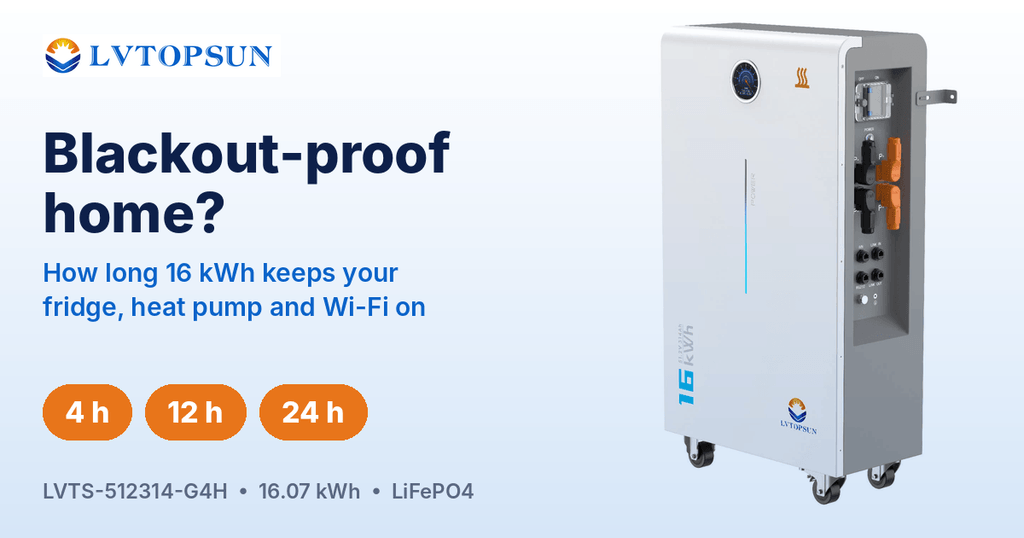
In this guide we calculate real runtimes for typical household devices and for three scenarios: a 4-hour evening outage, a 12-hour winter night and a full 24-hour blackout. We use the LVTOPSUN LVTS-512314-G4H (16.07 kWh) as the main example and the LVTS-512200-G3 (10.24 kWh) for comparison.
The short answer
- Essentials and cooking (fridge, router, lights, devices and three induction-hob meals) use about 5.3 kWh in 24 hours. One 16 kWh battery covers that with energy to spare.
- A heat pump changes everything. On a cold day it can use more energy than the rest of the house combined. A whole-house scenario with heating needs 1 battery for 4 hours, 2 for 12 hours and 3 for 24 hours.
- The battery alone is not enough. You also need a hybrid inverter with a backup output and a properly installed essential-loads circuit.
How to calculate battery runtime
The formula is simple:
Runtime (hours) = usable battery energy (kWh) ÷ load (kW)
The nominal capacity of the LVTS-512314-G4H is 16.07 kWh, but you will not get all of it at the socket. For planning we use a conservative figure:
| Step | Value | Comment |
|---|---|---|
| Nominal energy | 16.07 kWh | From the datasheet |
| Depth of discharge used | 90% | Planning assumption (the 8000-cycle rating is quoted at 90% DOD) |
| Inverter efficiency | 92% | Planning assumption |
| Usable energy | about 13.3 kWh | 16.07 × 0.9 × 0.92 |
| Usable energy, LVTS-512200-G3 (10.24 kWh) | about 8.5 kWh | Same assumptions |
Your real figures depend on the inverter, the discharge limit you set and the temperature. Treat the results below as planning estimates, not guarantees.
Runtime of single appliances
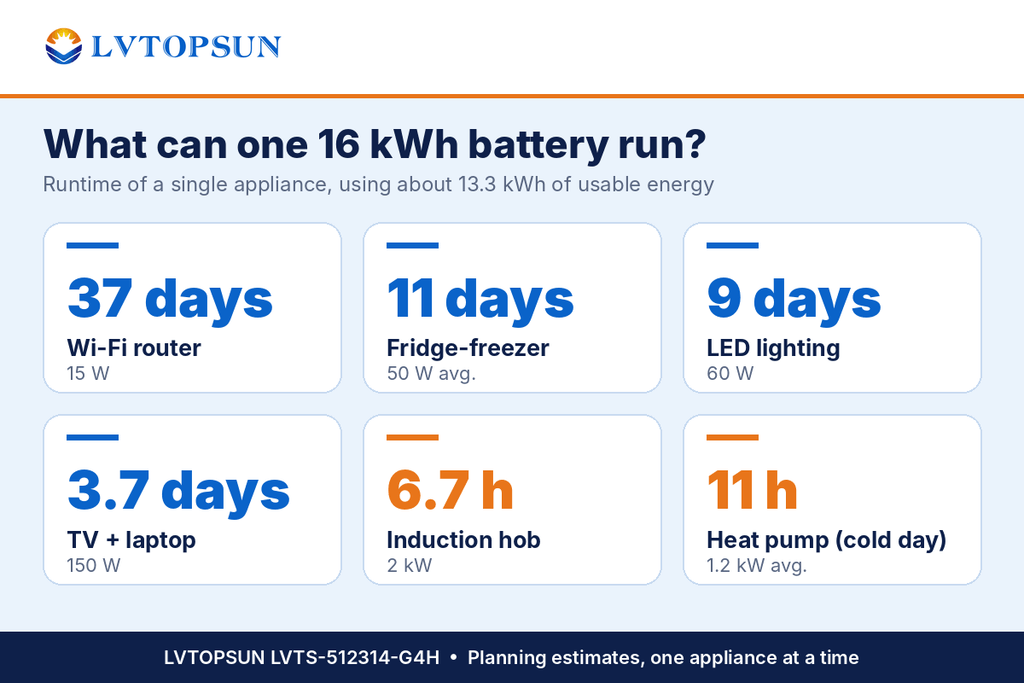
The table shows how long one battery could run each device on its own, running continuously at the power level given.
| Device | Typical power | LVTS-512314-G4H (13.3 kWh usable) | LVTS-512200-G3 (8.5 kWh usable) |
|---|---|---|---|
| Wi-Fi router and modem | 15 W | about 37 days | about 23 days |
| Fridge-freezer (average, about 1.2 kWh/day) | 50 W | about 11 days | about 7 days |
| LED lighting (6 bulbs) | 60 W | about 9 days | about 6 days |
| TV, laptop and phone charging | 150 W | about 3.7 days | about 2.4 days |
| Induction hob (medium, two zones) | 2 kW | about 6.7 hours | about 4.2 hours |
| Air-to-water heat pump (cold day average) | 1.2 kW | about 11 hours | about 7 hours |
| Air-to-water heat pump (very cold, high load) | 2.5 kW | about 5.3 hours | about 3.4 hours |
A few notes on these numbers:
- A fridge does not draw 50W all the time. The compressor cycles on and off and can briefly draw 150W or more when it starts. The 50W figure is a daily average.
- An induction hob is never on for 6.7 hours straight. The figure just shows how much energy cooking uses compared with the devices above it.
- Heat pump consumption varies the most. According to PickHVAC, a central heat pump typically draws about 1.5 to 3.5 kW while running, which equals roughly 15 to 60 kWh per day of heating depending on size and weather. In a well-insulated all-electric home described by RENEW, heating used an estimated 10 to 15 kWh per day in winter. We use 1.2 kW as a day-long average for a well-insulated home on a cold day, and show the 2.5 kW case as a stress test.
Three blackout scenarios: 4, 12 and 24 hours
Real households run many devices at the same time. We built three packages:
- Essentials: fridge-freezer, router, LED lighting, TV, laptop and phone charging.
- Essentials plus cooking: the above, plus induction-hob meals (1 kWh for one dinner in 4 hours, 1.5 kWh for two meals in 12 hours, 2.5 kWh for three meals in 24 hours).
- Whole house with heat pump: everything above, plus a heat pump averaging 1.2 kW.
Energy needed (kWh)
| Package | 4 hours | 12 hours | 24 hours |
|---|---|---|---|
| Essentials | 0.95 | 1.74 | 2.82 |
| Essentials plus cooking | 1.95 | 3.24 | 5.32 |
| Whole house with heat pump | 6.75 | 17.64 | 34.12 |
How many batteries do you need?
| Package | 4 hours | 12 hours | 24 hours |
|---|---|---|---|
| Essentials plus cooking | 1 battery | 1 battery | 1 battery |
| Whole house, LVTS-512314-G4H (13.3 kWh usable) | 1 battery | 2 batteries | 3 batteries |
| Whole house, LVTS-512200-G3 (8.5 kWh usable) | 1 battery | 3 batteries | 5 batteries |
What this means in practice
4-hour evening outage. One battery handles even the whole-house scenario, with about half of the usable energy left. You can cook dinner, watch TV, keep the internet on and heat the house.
12-hour winter night. Essentials and cooking use only about a quarter of one LVTS-512314-G4H. Adding a heat pump takes you to roughly 17.6 kWh, so you need two 16 kWh units, or one battery plus a plan to lower the heating setpoint.
24-hour blackout. Without heating, one battery is more than enough: essentials and three meals use about 40% of its usable energy. With a heat pump running all day, plan for three LVTS-512314-G4H batteries. If you have solar panels, daytime production can recharge the battery, although in December in central Europe the contribution is small.
Why the heat pump is the biggest variable
Heating demand depends on outdoor temperature, insulation, flow temperature and how the house is used. On a mild day (around +5°C) a heat pump may average well below 1 kW. In a deep freeze it can run for many hours at 2 to 3 kW, and it also uses energy for defrost cycles and hot water. That is why we show a range instead of one figure.
There are practical ways to reduce the load during an outage:
- lower the room setpoint by 1 to 2°C;
- turn off hot-water heating, or run it only once;
- heat only the rooms you use;
- avoid running the induction hob and heat pump compressor at the same moment.
For a deeper look at how LVTOPSUN batteries behave in cold conditions, read our article on the winter-ready LVTS-512314-G4H.
What you need besides the battery
This is the part many buyers miss. A battery on its own does not keep your house running during a blackout. You need:
- A hybrid inverter with a backup (EPS) output. Some grid-tied systems are installed without backup. Check the inverter specification and its backup power rating.
- An essential-loads circuit. Usually you connect the fridge, lights, router, sockets and heating circulation to a separate backup panel instead of the whole house.
- A qualified electrician. Backup wiring, grounding and automatic changeover must be done to local standards.
- A power check. Add up the devices that may start at the same time. For example, a heat pump (about 3 kW at start-up), an induction hob (up to 3.7 kW), a fridge (0.15 kW) and electronics (0.3 kW) come to roughly 7 kW. The LVTS-512314-G4H can deliver up to 10.24 kW (200 A), but the inverter’s backup rating is usually the limit.
- A compatible inverter. LVTOPSUN batteries are tested with Deye, Sofar, Sungrow, Solis, SMA and FoxESS. See our inverter compatibility test for details.
If you are choosing a system from scratch, our guide on how to choose a residential energy storage system explains the main decisions step by step.
Which LVTOPSUN battery fits your household?
LVTS-512314-G4H: 16 kWh floor-standing battery
- 51.2 V, 314 Ah, 16.07 kWh LiFePO4;
- up to 10.24 kW discharge power (200 A) and 7.68 kW charge power (150 A);
- discharge from -20°C to 55°C and charging from -20°C to 45°C, with low-temperature self-heating;
- 8000 cycles at 90% DOD, 25°C and 0.5C, and a 10-year warranty;
- automatic fire-extinguishing device and smart BMS;
- IP65 protection, floor stand with wheels, 480 × 235 × 874 mm, 120 kg;
- RS232, RS485 and CAN communication, plus Bluetooth and WiFi;
- up to 63 batteries in parallel.
It is the better choice for homes with heat pumps, long outages or growing energy needs. Because up to 63 units can be connected in parallel, you can start with one battery and add more later.
LVTS-512200-G3: 10.24 kWh power wall
The LVTS-512200-G3 (51.2 V, 200 Ah, 10.24 kWh LiFePO4) is a more compact option for households that mainly want to protect essentials and cooking. As the table shows, it covers the “essentials plus cooking” package for 24 hours with room to spare.
Both models are available from our European warehouse in Poland. Read more about fast delivery from the LVTOPSUN Poland warehouse, or browse the full LiFePO4 battery range.
Five ways to stretch your battery during a blackout
- Cut non-essential loads. Disconnect the washing machine, dryer, oven and electric water heater from the backup circuit.
- Keep the fridge closed. Every opening makes the compressor work harder.
- Use LED lighting and charge devices once. Fill up phones and laptops while power is available.
- Cook efficiently. Use lids, a smaller zone for the pot size and a kettle for hot water.
- Keep the battery charged before storms. If your system supports it, set a reserve level (for example 50 to 100%) so the battery is not used for peak-shaving or price arbitrage ahead of bad weather. If you use dynamic tariffs, our article on dynamic tariffs and negative prices explains how to balance savings with backup.
Is a backup battery worth it?
A backup battery pays back in two ways: you gain security during outages, and the same battery saves money every day by storing cheap or solar energy. Our guide to home energy storage ROI shows how to calculate both. If you live in Poland, also read about the Polish residential storage market and available incentives.
Frequently asked questions
How long will a 16 kWh battery last in a power cut? It depends on the load. Essentials such as a fridge, router, lighting and electronics use under 3 kWh per day, so one battery can run them for several days. With a heat pump on a cold day, a 16 kWh battery may last about 11 hours.
Can a home battery run a heat pump? Yes, if the inverter’s backup output can supply the heat pump’s start-up current and the heat pump circuit is connected to the backup panel. Check the heat pump’s power, the inverter rating and the wiring with your installer.
Can a battery run an induction hob? Yes. A hob uses between about 1.4 and 3.7 kW depending on the number of zones and power level, which is within the LVTS-512314-G4H’s 10.24 kW maximum discharge power. Cooking a family dinner typically uses about 1 kWh.
Will my battery work in a blackout without an inverter? No. The battery needs a hybrid inverter with a backup output. Without it, the system disconnects from the grid for safety and the house has no power.
How many batteries do I need for a 24-hour blackout? For essentials and cooking, one LVTS-512314-G4H is enough. For a whole house with a heat pump on a cold day, plan for about three.
Does cold weather reduce runtime? LiFePO4 batteries can lose some usable capacity in cold conditions, and the heat pump uses more energy at low temperatures. The LVTS-512314-G4H supports discharge down to -20°C and has low-temperature self-heating.