Europe is installing batteries at a record pace. According to EUPD Research, annual battery storage installations across Europe are projected to grow from 34 GWh in 2025 to 65 GWh in 2026. A slightly earlier estimate from the same research house, published in September, put the 2026 figure at 57 GWh, a rise of about 78% on the year. The two numbers differ because of timing and geographic scope, but the direction is the same: demand is rising fast.
For solar installers, EPC contractors and distributors, this is good news. It is also a warning. A bigger market attracts more suppliers, tighter margins and more demanding customers. In this article we look at what is driving the growth, where the opportunity for residential and small commercial projects really is, and how to choose a battery supplier in a more competitive market.
Europe’s battery storage market in numbers
| Indicator | Figure | Source |
|---|---|---|
| Annual installations in 2025 | About 34 GWh | EUPD Research, Oct 2026 |
| Projected installations in 2026 | 57–65 GWh (depending on the report and scope) | EUPD Research, Sept and Oct 2026 |
| Utility-scale share of 2026 installations | Around 44 GWh | EUPD Research, Oct 2026 |
| Residential installations in 2026 | Roughly 15 GWh, up from about 11 GWh | EUPD Research |
| Home batteries installed in Germany | About 2.1 million | Industry estimate, late 2025 |
| Home batteries installed in Italy | About 780,000 | Industry estimate, late 2025 |
The scope in EUPD’s October calculation covers the EU, the UK, Switzerland, Norway and Ukraine. Residential storage is therefore growing more slowly than the market as a whole, but it is still adding roughly one third more capacity than a year ago.
What is driving the growth?
EUPD Research points to several forces working together.
High retail electricity prices. Prices have eased from the peaks of the energy crisis, but in many countries they remain high enough to make self-consumption attractive.
Falling battery costs. LiFePO4 cells are cheaper than a few years ago, which shortens payback periods for households.
Changing solar tariffs. As payments for exported rooftop solar energy decline and net-metering schemes are phased out in several countries, storing midday solar power for the evening becomes the logical next step.
Tax breaks and VAT exemptions. Several countries still reduce the cost of storage for households, although some subsidy programmes are being gradually reduced.
Energy independence. Grid uncertainty and dynamic pricing push more homeowners to ask for a battery together with solar panels, a heat pump or an EV charger.
In short, batteries are moving from an optional extra to a core part of the electricity system. They are no longer sold only as backup power.
Two markets growing in different ways
The fastest growth comes from utility-scale projects. EUPD expects a record of around 44 GWh of grid-connected storage in 2026. These projects are led by large, specialised EPC companies and are not the typical business of a local installer.
The residential and small commercial segment is different. EUPD expects roughly 15 GWh of new home battery capacity in 2026, with Germany, Italy, the Netherlands, Austria and the United Kingdom among the strongest markets. Earlier in the year, EUPD also listed Bulgaria and Spain among the countries leading overall growth.
For local installers and regional distributors, this means the opportunity is real, but it is a more competitive and more mature one. Customers are better informed, and manufacturers now compete on complete home energy systems instead of simple batteries.
The challenges installers still face
The same EUPD analysis lists several obstacles that will shape 2026 and 2027:
- uneven smart-meter rollout across countries;
- financing constraints for households;
- shortage of skilled installation labour;
- gradual reduction of subsidy programmes in some markets;
- a more fragmented supplier landscape. In Germany, for example, the combined share of the largest residential suppliers fell between 2025 and the first half of 2026, while mid-sized and smaller brands gained ground.
There is also a supply-side trend worth noting: Chinese manufacturers hold a leading position in Europe’s home battery market. For European buyers, the question is therefore no longer “where is the battery made?” but “how well is the supplier set up to serve me in Europe?”
How to choose a battery supplier in a crowded market
When many brands offer similar capacity and price, the difference is made by details. We suggest installers and distributors check the following.
1. Cell quality and cycle life. Ask for the cycle rating together with the test conditions (depth of discharge, temperature, charge rate). A figure without conditions tells you very little.
2. Safety design and certificates. Look for IEC 62619, CE and CB certification, plus practical safety features such as temperature monitoring and fire-suppression systems.
3. Inverter compatibility. A battery that works with the major hybrid inverter brands saves commissioning time. Ask which brands have actually been tested.
4. Operating temperature range. Many European customers install batteries in garages and utility rooms where temperatures drop in winter. Check charging limits at low temperatures.
5. Scalability. Customers often start small and add capacity later. Check how many units can be connected in parallel.
6. Local stock and support. Long lead times from Asia can delay projects and tie up cash. A supplier with stock in Europe and a local company can ship faster and handle warranty questions more easily.
7. Warranty length. A long warranty only matters if the supplier will be around to honour it. A European entity makes that easier to verify.
Example: what a modern 16 kWh floor-standing battery offers
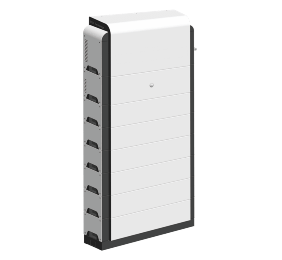
The LVTOPSUN LVTS-512314-G4H is designed around these criteria. According to the manufacturer’s datasheet, it offers:
- 51.2 V nominal voltage, 314 Ah capacity and 16.07 kWh of battery energy;
- LiFePO4 (lithium iron phosphate) cells;
- 8000 cycles at 90% depth of discharge, 25°C and 0.5C;
- a 10-year warranty;
- IP65 protection rating;
- charging from -20°C to 45°C and discharging from -20°C to 55°C, with low-temperature self-heating;
- up to 63 batteries in parallel;
- RS232, RS485 and CAN communication, plus Bluetooth and WiFi;
- an automatic fire-extinguishing device and a smart BMS;
- certificates including IEC62619, CE-EMC+RF, RoHS, CB63056 and UKCA;
- a floor-stand design with wheels, 480 × 235 × 874 mm and 120 kg.
A quick calculation shows why cycle life matters. At 90% depth of discharge, 8000 cycles correspond to roughly 115 MWh of energy delivered over the life of one 16.07 kWh unit (16.07 kWh × 0.9 × 8000). Real results depend on operating conditions, but it explains why cycle rating is one of the first numbers professionals compare.
A regulatory note for 2027
Installers and distributors should also keep an eye on the EU Batteries Regulation (EU) 2023/1542. From 18 February 2027, industrial batteries above 2 kWh placed on the EU market, including stationary energy storage systems, will need a digital battery passport. Ask your suppliers how they are preparing, so you are not left with non-compliant stock.
What installers and distributors should do now
- Define your niche. Utility-scale projects are dominated by large players. Residential and small commercial storage rewards speed, local knowledge and good service.
- Offer complete systems. Customers increasingly want solar, battery, heat pump and EV charging working together. Make sure your battery supplier supports the inverters you already use.
- Reduce your inventory risk. Work with suppliers that hold stock in Europe so you can promise realistic delivery dates.
- Check compliance early. Ask for certificates and for the supplier’s plan for the 2027 battery passport.
- Train your team. Labour shortages are one of the biggest bottlenecks. Clear commissioning guides and technical support reduce time on site.
Frequently asked questions
How big is Europe’s battery storage market in 2026? EUPD Research projects annual installations of 57 to 65 GWh in 2026, depending on the report and the countries included. That compares with about 34 GWh in 2025.
Is residential storage growing as fast as utility-scale storage? No. Utility-scale projects are the main growth engine, with around 44 GWh expected in 2026. Residential storage is expected to reach roughly 15 GWh, which is still a significant increase on the year before.
Which European countries are the biggest home battery markets? Germany has the most home batteries installed, followed by Italy. EUPD expects Germany, Italy, the Netherlands, Austria and the United Kingdom to remain among the strongest residential markets in 2026.
Why is LiFePO4 the preferred chemistry for home storage? LiFePO4 batteries offer long cycle life and good thermal stability, which makes them well suited to daily cycling in homes.
Do I need a battery passport for home batteries in 2027? From 18 February 2027, industrial batteries above 2 kWh placed on the EU market, including stationary storage systems, are in scope. Confirm the details with your supplier and the regulation text.